

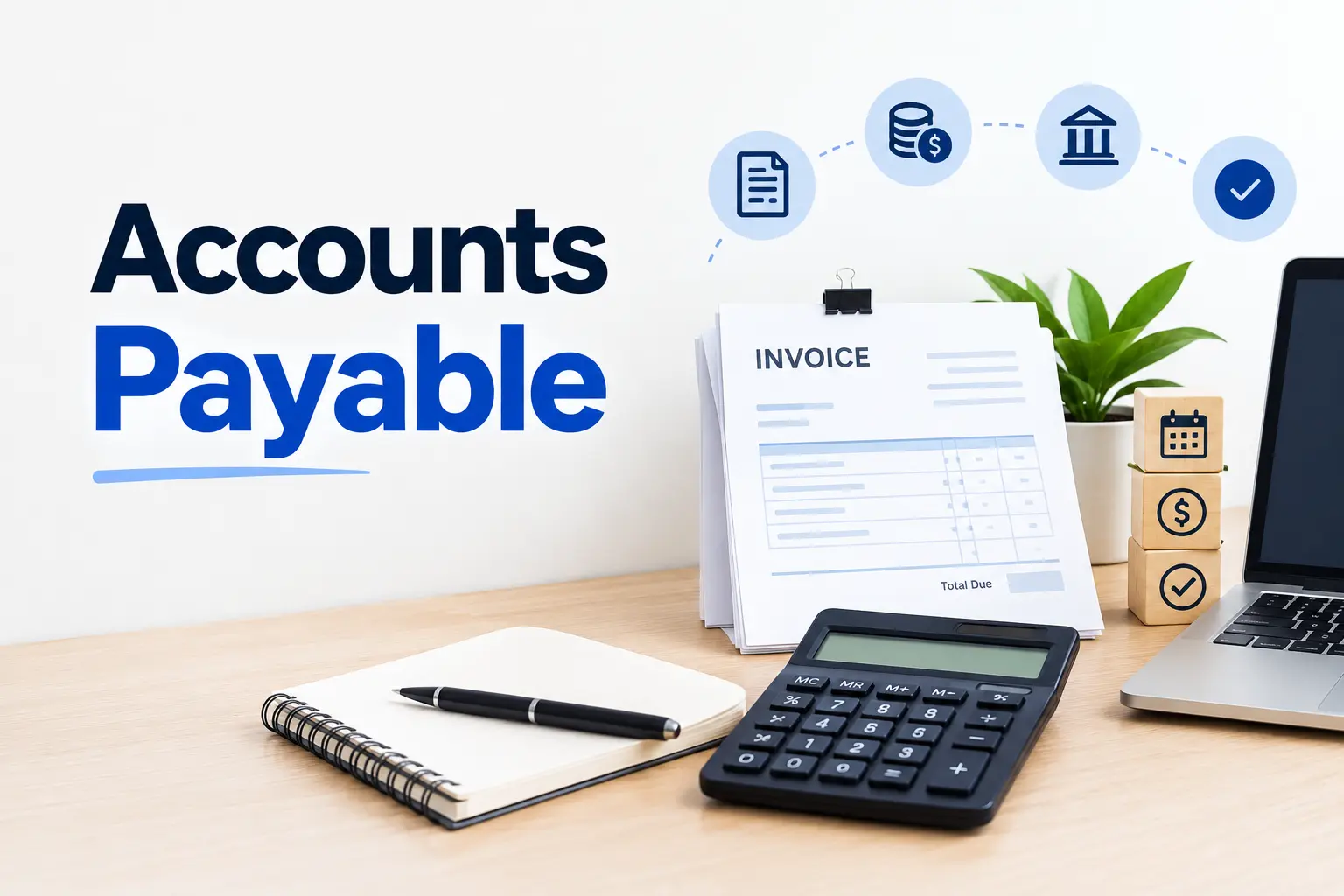
A stack of supplier invoices is sitting in your inbox again, and you're not entirely sure what to do with them beyond paying whenever you get round to it. That pile has a name: accounts payable. Getting a proper handle on it is one of the simplest ways to protect your cash flow and catch mistakes before they cost you real money.
Here's how it actually works, whether it's worth handing off to someone else, and how to stop it turning into a monthly scramble.
What Is Accounts Payable, in Plain Terms?
Accounts payable is the money your business owes suppliers for goods or services you've already received but haven't paid for yet. Say a supplier delivers stock and gives you 30 days to settle up. That unpaid invoice sits there until it's paid off. On your balance sheet, it appears as a current liability, essentially a short-term debt hanging over the business.
People constantly mix it up with accounts receivable, and honestly, it's easy to see why. They're two sides of the same coin. One is what you owe. The other is what's owed to you. Getting them confused in conversation is harmless enough. Getting them backwards in your actual books is where real problems start.
Trade Credit: Why This Isn't All Bad News
Here's the bit a lot of business owners never quite clock. It isn't just an admin headache. It's a genuine form of short-term financing. When a supplier gives you 30 or 60 days to pay instead of demanding payment upfront, that's trade credit, and it means you can use their goods or services now while keeping your own cash a little longer. Handled properly, this actually helps your cash flow. Handled poorly, it leads to missed payments, strained supplier relationships, and a last-minute scramble every month.
Trade Accounts Payable: How the Process Actually Works
Once it's set up properly, the process itself isn't complicated. An invoice comes in by email, post, whatever channel the supplier uses. It gets logged straight away rather than left to pile up on a desk somewhere. Where it makes sense, it gets checked against what was actually ordered and delivered, a step often called the "3-Way Match", comparing the purchase order, the delivery confirmation, and the invoice itself. Line all three up, and it's approved and scheduled for payment.
That matching step matters more than it sounds like it should. More than half of UK small businesses have faced invoice fraud at some point, often duplicate invoices or slightly tweaked payment details slipping through simply because nobody double-checked. A consistent process, even a basic one, closes most of that gap on its own.
Should You Handle This Yourself, or Hand It Off?
At some point, most growing businesses ask the same question: is it worth bringing in help, or keeping this in-house? Accounts payable outsourcing services exist for exactly this reason: they take invoice logging, matching, and payment scheduling off your plate entirely, while you keep full visibility into what's going out and when.
It's not just for larger companies either. Plenty of small businesses choose to outsource accounts payable services once the monthly invoice count starts eating into hours better spent elsewhere. The trade-off is straightforward. In-house gives you direct, hands-on control. Outsourcing gives you back your time and, usually, a second set of eyes catching errors your own team might miss under pressure.
Where VAT Fits Into Your Records
One thing that constantly trips people up: the recorded figure typically includes VAT. When you come to reclaim it on your return, that reclaimable portion is separated into a VAT control account rather than being lumped in with the supplier debt. Keep that distinction messy, and VAT reconciliation becomes a far bigger headache than it needs to be at filing time.
FAQs
1: Does this show up on my profit and loss statement?
No. It sits on the balance sheet as a liability, not on the income statement. Expenses get recorded when they're incurred, while this simply tracks what's still owed.
2:How often should I be reviewing this?
Weekly works best for most small businesses; monthly is the absolute minimum. Leave it until month-end, and errors and missed payments become much more likely, with less time to query anything.
3: Is outsourcing worth it for a very small business?
Often, yes, once you're past a handful of invoices a month. The time saved and errors caught typically outweigh the cost, though a micro-business with only a few bills monthly might manage fine with a tidy in-house process for now.
Keep It Accurate, Without It Falling on You
This is one of those things that seems minor right up until a missed payment or an unnoticed duplicate invoice costs real money. At Malik AccounTax, we manage this as part of our bookkeeping service for businesses across Edinburgh and the UK, whether you want to keep it in-house with our support or hand the whole process to us.
Not sure your process is watertight? Call Malik AccounTax today and let's take a look.
0131 287 7599